Battle on 'Bago Ice Fishing Tournament

5th Annual Tournament
Feb. 24 - 25, 2012
Lake Winnebago
Oshkosh, Wisconsin
info@battleonbago.org


About Lake Winnebago

The Largest Freshwater Lake Entirely Within a U.S. State

The lake is characterized by having many shallow reefs along the west shore, and a drop-off type shoreline on the east. There are several islands along the west shore.

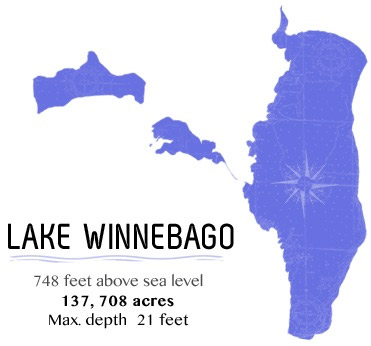
Lake Winnebago has two primary tributaries, the Wolf River and the Fox River. It is drained by the Fox River which flows north towards the Bay of Green Bay and serves as part of the Fox-Wisconsin Waterway. Lake Winnebago is part of a larger system of lakes in Wisconsin known as the Winnebago Pool.It has a maximum depth of 21 FEET.

Some of the communities on its shores include Oshkosh, Fond du Lac, Neenah and Menasha. Cities that draw their drinking water directly from Lake Winnebago include Oshkosh, Neenah, Menasha and Appleton.


Wisconsin Department of Natural Resources

Maps

Contour (Bathymetric) Map (PDF)
Interactive Map


Newsletter Sign Up

Enter your email address to receive annual updates and the tourney results as soon as they are posted.


Lake Winnebago Facts

  • 10 miles x 30 miles
  • 137,708 acres
  • 88 miles of shoreline
  • Average depth: 15.5 ft.
  • Max. depth: 21 ft.

Ice Fishing Safety Tips

  • Clear, solid ice at least two inches thick is usually sufficient to hold a single person walking on foot. For safety’s sake, wait until the ice is at least three inches thick and go with a friend. Keep a least 50 feet of distance between each other. Ice fishing with several friends and gear requires at least four inches of ice, and snowmobiles and ATV’s five inches.
  • Ice will generally be thicker near shore and get thinner as one ventures out. Check ice thickness with an ice spud or auger starting from a few feet from shore and every 10 to 20 feet as one goes towards the middle of the waterway.
  • Lake ice is generally stronger than river ice. Springs, lake inlets and outlets, and channels can alter ice thickness.
  • Before heading out onto early or newly formed ice, check with a local bait shop, resort owner, or outdoors store regarding ice thickness or known thin spots.
  • Whether alone or with a friend on early ice, always carry a couple of large sharpened nails and a length of rope in an easily accessible pocket. The nails or commercially bought ice grabbers can help a person pull themselves out of the water an on to more solid ice. The rope can be thrown to another person for rescue.
  • If you are alone and go through the ice, take a few seconds to get over the “cold shock.” Regain your breathing, kick hard and try to swim up onto the ice. If successful, crawl on your hands and knees or roll to more solid ice. Get to the nearest warm place quickly. If your attempts to swim onto the ice area unsuccessful, get as much of your body out of the water and yell for help. Studies show you will have about 30 minutes or more before the body is incapacitated by hypothermia.
  • Proper clothing can increase chances of survival should a person break through the ice. A snowmobile type suit if it is zipped can and will trap air and slow the body’s heat loss. Once filled with water, however, insulated suits become heavy and will hinder rescue. Newer model snowmobile suits have flotation material built in and anyone traversing ice should consider purchasing one of these suits. On early ice it is advised to wear a personal flotation device.
  • Refrain from driving on ice whenever possible. Traveling in a vehicle, especially early or late in the season, is an accident waiting to happen.
  • When driving on ice be prepared to leave the vehicle in a hurry. Unbuckle the seatbelt and have a simple plan of action in case of ice break through. Anglers may want to leave a window open for an easy exit.
  • Often vehicles will establish roads from shore to the current fishing hotspots. Repeated vehicle use may cause the ice to weaken. The ice roads may not always be the safest routes.
  • When using a gas or liquid heater to warm an ice shack or tent make sure it is properly ventilated with at least two openings, one at the top and one at the bottom of the structure. Any flame eats oxygen so proper ventilation is required.

Source WDNR http://dnr.wi.gov/


Our Awesome Sponsors!


Fleet FarmMercury

FrabillJiffyDuck Bay LodgeAssociated BankNorthland Fishing TackleeaglelakesFestival FoodsMiller LightBadger SportsmanCritters